

Specification
Deskripsi
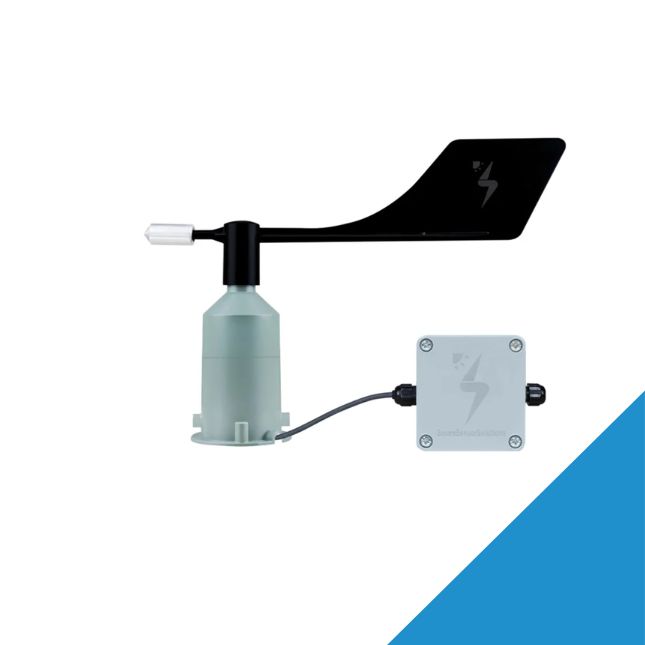
TECHNICAL SPECIFICATIONS OF PLATIC WIND DIRECTION SENSOR WITH MODBUS OUTPUT
| Item Code | 3S-WD-MB-P |
| Sensor Type | Vane-Driven Hall Effect Position Sensor |
| Measuring Range | 0 to 359° |
| Accuracy | ±1% of Measuring Value |
| Resolution | 0.1° |
| Threshold | 1 m/s |
| Data Output | RS485 up to 38400 Baud |
| Communication Protocol | Modbus RTU |
| Power Supply | 12 to 30 V DC (24 V DC recommended) |
| Power Consumption | Typically 20 mA @ 24 V DC |
| Electrical Connection | 1 m 3x2x0,22 mm² – LI2Y(st)C11Y Cable, UV and Weather Resistant |
| Operating Temperature Range | -40°C to +85°C (Ice Free) |
| Dimensions | 265 mm x 190 mm |
| Box Dimensions | 80 x 82 x 55 mm (W x L x H) |
| Weight | 0,33 kg |
| Box Weight | 0,25 kg |
| IP Rating | IP 54 |
| Housing Material | ASA |
| Vane Material | P6GF20 |
| Box Material | ABS |
| Mounting Method | Pipe or Ground Mounting |
| Standard | Compliant to IEC 61724-1:2021 |
How Does the Plastic Modbus Wind Direction Sensor Work?
The sensor measures wind direction by tracking the position of the wind vane and transmitting the value digitally via Modbus RTU.
- Wind turns the vane so it points into the wind direction.
- A built-in Hall Effect sensor detects the vane’s angle without physical contact, which helps reduce wear and keeps readings stable over time.
- The sensor converts the measured angle into a wind direction value in degrees (0 to 359).
- This value is sent as digital data using Modbus RTU over RS-485, which is reliable for long cable runs and electrically noisy environments.
- The wind direction data is stored in Modbus registers, so your datalogger, PLC, inverter, or SCADA system can read it at regular intervals.
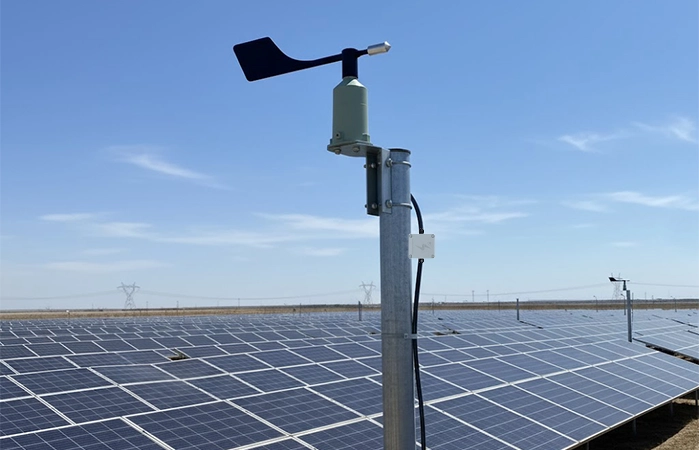
This working principle makes the sensor well suited for PV plants, weather stations, and remote monitoring sites, where long cable runs, low maintenance, and reliable data transmission are essential.
Where Is the 3S-WD-MB-P Commonly Used?
This Modbus wind direction sensor is widely deployed in:
- Utility-scale solar PV plants
- Hybrid solar-wind installations
- Meteorological stations
- Environmental and climate monitoring systems
- Agricultural PV and smart farming projects
In PV applications, wind direction data supports thermal loss analysis, soiling assessment, and structural risk evaluation, as required by IEC 61724-1.


