

Deskripsi
TECHNICAL SPECIFICATIONS OF HEATED WIND SPEED SENSOR WITH MODBUS OUTPUT
| Sensor Type | Cup-Driven Hall Effect Position Sensor |
| Measuring Range | 0,5 to 75 m/s |
| Accuracy | ±0,5 m/s below 5 m/s; ±10% of reading above 5 m/s |
| Resolution | 0,1 m/s |
| Threshold | 0,5 m/s |
| Data Output | RS485 up to 38400 Baud |
| Communication Protocol | Modbus RTU |
| Power Supply | 18 to 30 V DC (24 V DC recommended) |
| Power Consumption | Typically @ 24V DC; Heating ON: 1 A Heating OFF: 53 mA |
| Cable Length & Features | 1 m, 3x2x0.22 mm², LI2Y(st)C11Y, UV and weather resistant |
| Operating Temperature Range | -40°C to +85°C |
| Operating Humidity Range | 0 to 100% RH |
| Dimensions | 203 mm x 263 mm |
| Weight | 0,34 kg |
| IP Rating | IP54 |
| Housing Material | Aluminum and Polyamide |
| Cup Material | ABS |
| Mounting Method | Pipe or Ground Mounting |
| Standard | IEC 61724-1:2021 |
| Heating Range | Blue light: Internal aluminum temp > 10°C (no heating) Red light: Internal aluminum temp ≤ 10°C (heating starts); heating stops at ≥ 20°C |
| Origin | Türkiye |
Why Use a Heated Wind Speed Sensor Instead of a Standard One?
Standard anemometers can fail in winter conditions. When ice forms on the rotating cups, the mechanism slows down or stops completely and the data you receive becomes unreliable or simply disappears.
The 3S-WS-MB-H solves this with an automatic heating system controlled by an internal temperature sensor. When conditions threaten to freeze the sensor, the heating element kicks in without any manual intervention. The result is continuous, trustworthy wind speed data even in cold climates.
How Does the Heated Wind Speed Sensor Work?
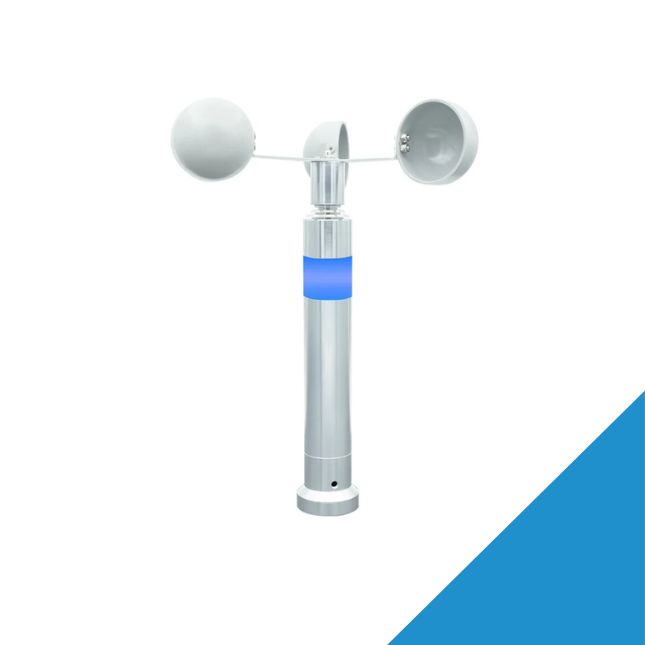
The sensor uses three rotating cups to capture wind movement. As wind pushes the cups, they spin at a speed proportional to the wind. Inside the sensor, a Hall Effect Position Sensor detects the rotation via a magnetic field and converts it into a digital signal representing wind speed in m/s.
This signal is then transmitted over RS-485 using the Modbus RTU protocol, which allows for reliable communication over long cable runs, often hundreds of meters, without signal degradation.
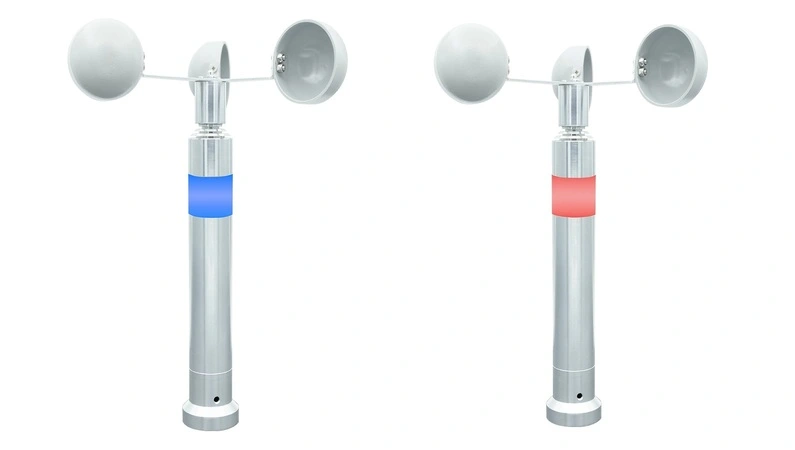
The heating function runs separately and automatically. An internal temperature sensor continuously monitors conditions. When the internal aluminum temperature drops to 10°C or below, the red indicator light turns on and heating starts. When the temperature reaches 20°C, heating stops and the blue light comes on. This keeps the sensor within a safe operating range without wasting energy.
How Does the Heating Function Operate?
The heating logic is simple and automatic:
| Internal Aluminum Temperature | Heating Status | Indicator |
| Above 10°C | OFF | Blue light |
| 10°C or below | ON (heating starts) | Red light |
| Reaches 20°C | OFF (heating stops) | Blue light |
This temperature-based control protects the sensor without requiring any configuration from the user. Once installed and powered, it handles cold conditions on its own.
Where Is the 3S-WS-MB-H Commonly Used?
The 3S-WS-MB-H is a practical choice for any site where accurate wind speed data must be maintained through winter or in challenging climates. Typical applications include:
- Solar power plants in cold or high-altitude regions
- Mountain and highland meteorological stations
- Remote environmental and industrial monitoring sites
- Offshore and coastal installations subject to icing
- Research stations in cold climate zones
How Do You Install the 3S-WS-MB-H?
Installation is straightforward:
- Mount the sensor on a suitable pipe or ground structure using the supplied M5 screws.
- Position it in an open area with clear exposure to wind away from buildings, trees, or anything that could block or deflect airflow.
- Connect the power supply (18–30 V DC, 24 V DC recommended) and RS-485 communication lines according to the Modbus wiring diagram.
- Power on the sensor and verify communication with your SCADA, datalogger, or PLC.
- Check the indicator light to confirm heating status during the first cold weather cycle.
What Maintenance Does the Sensor Need?
Thanks to the Hall Effect sensing principle, there are no contact-based components that wear quickly. In most installations, routine maintenance is minimal:
- Periodic visual inspection of the cups and housing
- Checking cable condition and mounting hardware
- Confirming the cups rotate freely (especially after heavy snowfall or icing events)
- Verifying communication and heating status during cold season inspections
For solar monitoring and professional meteorological installations, an annual scheduled inspection is a reasonable baseline. In harsher environments, more frequent checks may be appropriate.


