

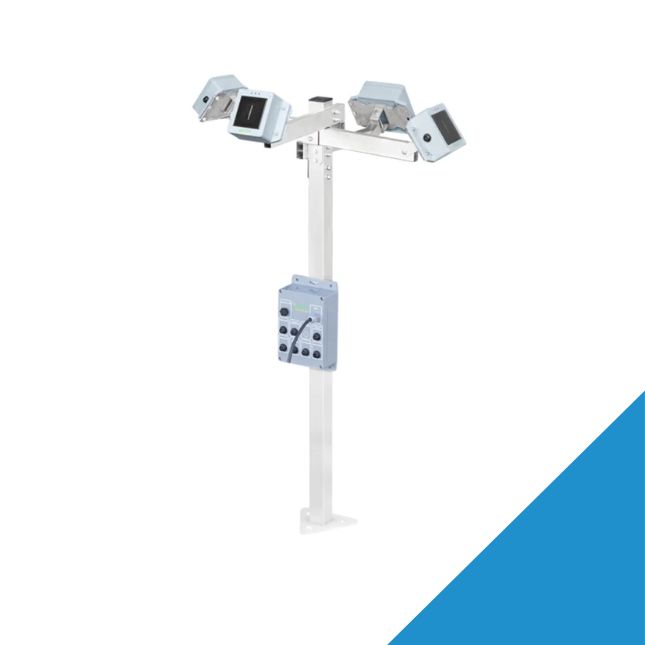
Seven Sensor Multi-Orientation Irradiance Sensor 3S-4IS
The 3S-4IS Multi-Orientation Irradiance Sensor is developed for PV plants with three or four different orientations. It supports accurate Performance Ratio (PR) calculations by producing a single effective irradiance value based on the number of panels installed in each direction. The panel count is set for each orientation, allowing the sensor to reflect the real distribution of the plant. Panel numbers for each orientation are entered through the 3S-4IS Configuration Tool. Using these inputs, the system calculates total effective irradiance and total effective module temperature and communicates them to the datalogger via Modbus RTU, enabling monitoring systems to calculate PR correctly for multi-orientation PV sites.
The 3S-4IS transmits both per-orientation values and plant-level effective values.
Typical measured/derived data include:
- POA irradiance and internal cell temperature for each orientation (up to 4 planes)
- Total Effective Temperature Compensated Irradiance (single plant input for PR)
- Module temperature per orientation (if module temp sensors are connected)
- Total Effective Module Temperature
- Ambient temperature
- Wind speed
- Wind direction
The SEVEN Multi Orientation Irradiance Sensor is designed to deliver reliable POA irradiance measurement with easy installation and seamless integration.
- PR that matches the real plant layout: Especially important for contractual performance tests and long-term benchmarking.
- Simple commissioning: Enter panel counts per direction once via the configuration tool. No external averaging scripts required.
- One communication line for all sensors: Cleaner wiring, fewer Modbus nodes, less chance of site-level integration drift.
- IEC-aligned accuracy: Designed to meet IEC 61724-1:2021 Class A requirements for PV monitoring.
- Cost effective: An alternative solution for seperating the site into independent sites for each orientation.
Product Details
Deskripsi
TECHNICAL SPECIFICATIONS OF MULTI ORIENTATION IRRADIANCE SENSOR
| Item Code | 3S-4IS |
| Electronic Box | |
| Connected Sensors |
Four Irradiance Sensors (3S-IS-mV)
Four Module Temperature Sensors (3S-MT-PT1000)
Ambient Temperature Sensor (3S-AT-PT1000)
Wind Speed Sensor (3S-WS-PLS)
Wind Direction Sensor (3S-WD)
|
| Data Output | RS485 up to 38400 Baud |
| Communication Protocol | Modbus RTU |
| Output Rate | 1/s |
| Operating Temperature Range | -40°C to +85°C |
| Box Metarial | ABS |
| Box Dimensions | 211 mm x 123 mm x 60 mm (LxWxH) |
| Box Weight | 450 gr |
| Box IP Rating | IP67 |
| Power Supply | 12 to 30 V DC |
| Power Consumption | 40 mA max @24 VDC |
| Electrical Connection | 3 m LIYYC11Y PUR Cable, UV and Weather Resistant |
| Galvanic Isolation | 1000 V between power supply and RS485 bus |
| Irradiance Sensors (3S-IS-mV) | |
| Reference Cell | Monocrystalline Silicon (31 mm x 31 mm) |
| Current Shunt | High precision shunt resistor directly soldered to the terminals of the cell |
| Irradiance Range | 0 – 1600 W/m² |
| Uncertainty | ≤1% (less than 2%; as per IEC61724-1 standard Class A) |
| Resolution | 0.1 W/m2 (less than 1W/m²; as per IEC61724-1 standard Class A) |
| Response Time | 1 sec. (less than 3 sec; as per IEC61724-1 standard Class A) |
| Drift | Very small drift of <0.3%/ year |
| Field of View | Larger than 160° as per IEC61724-1 standard Class A |
| Tilt-Azimuthal Angle | 0°- 0° , ≤ 1°; ° as per IEC61724-1 standard Class A |
| Data Output | mV Signal |
| Cell Temperature Sensor Type | PT1000 Class A as per EN 60751 |
| Box Dimensions | 140 mm x 110 mm x 42 mm (W x L x H) |
| Weight | 260 gr |
| IP Rating | IP54 (IP68 optional) |
| Sensor Housing Material | Aluminum |
| Standard | IEC 61724-1:2021 and IEC 60904 |
| Calibration | Each sensor is calibrated under Class AAA Sun Simulator as per IEC 60904-2 and IEC 60904-4 by using a reference cell calibrated by ISFH-Germany |
Why Do Multi-Orientation Plants Need Total Effective Irradiance?
Many sites no longer point in a single direction. Common examples:
- industrial roofs with east / west / south faces
- ground plants expanded in phases with mixed azimuths or tilts
- carports and canopies with several planes
- sites with different tracker blocks or fixed-tilt islands
In these layouts, each sub-array receives different POA irradiance at different times of day. If PR is calculated using only one POA sensor, the “solar input” is mismatched to the real plant.
Seven Sensor 3S-4IS avoids this by measuring each POA plane separately and then creating one effective irradiance value that represents the whole field based on the plant’s orientation split.


