
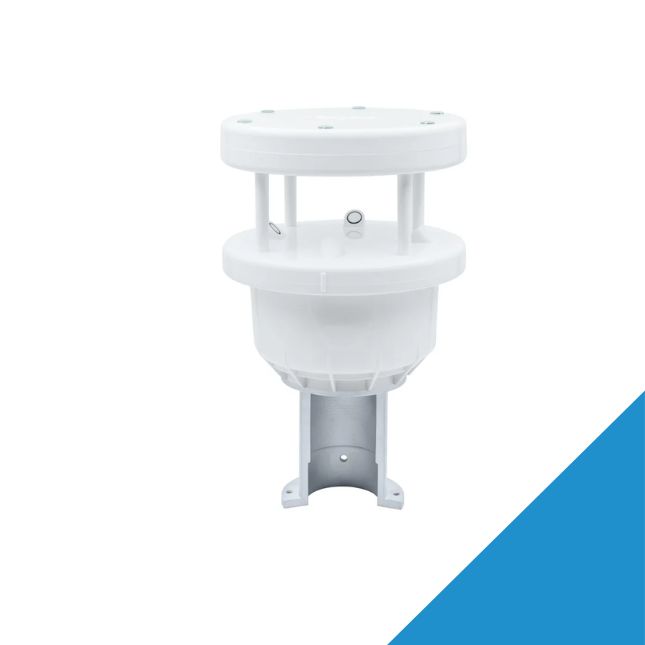
Seven Sensor Ultrasonic Anemometer 3S-UA

Seven Sensor 3S-UA is an ultrasonic anemometer that measures wind speed and wind direction without using any moving parts. Unlike mechanical cup-and-vane anemometers, it contains no rotating parts. It performs measurements using ultrasonic technology and provides both speed and direction data in a single, compact housing. It is used in areas such as weather stations, wind farms, ports, airports, and building facades.

The measured data is transmitted to data loggers and monitoring units via Modbus RTU digital output. The device has WMO-No.8 measurement compatibility.

What is an Ultrasonic Anemometer Used For?

An anemometer is a device that measures wind speed and direction in a given area. This data is used in many fields, such as performance evaluation in solar and wind power plants, weather observation in meteorological stations, and operational safety in ports and airports.

The 3S-UA performs this measurement without any moving parts. This means you can continuously measure both wind speed and direction with a single device, without worrying about mechanical wear.

How Does an Ultrasonic Anemometer Work?
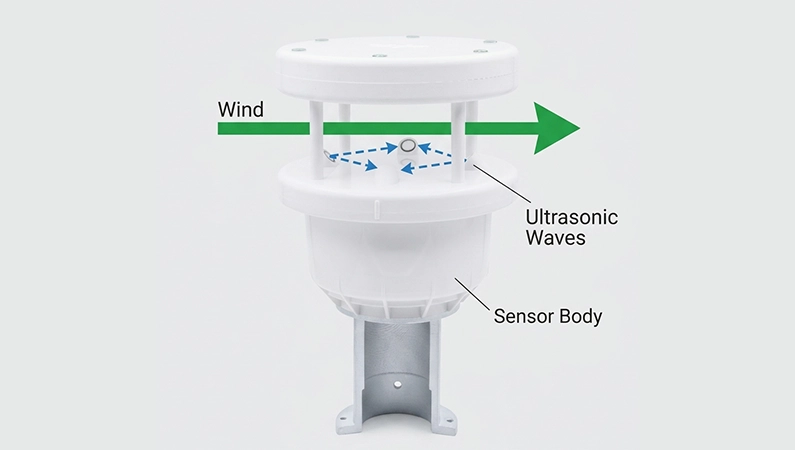
How Does an Ultrasonic Anemometer Work

An ultrasonic anemometer sends and receives ultrasonic sound pulses between opposing sensors (transducers) in its body. Wind causes these pulses to travel faster in one direction and slower in the opposite direction. By measuring this difference in the time it takes for the pulses to travel back and forth, the device calculates both the speed and direction of the wind.

Because the measurement is entirely electronic, there are no rotating or friction-generating parts. This allows for both the precise detection of very low wind speeds and the rapid capture of sudden wind gusts and changes in direction. The response time is 1 second.

14 People watching this product now!

Product Details

Specification

Deskripsi

Technical Specifications of Ultrasonic Anemometer

Item Code 3S-UA
Sensor Type Ultrasonic
Measured Data Wind speed and wind direction
Wind Speed Range 0…75 m/s
Wind Direction Range 0…360°
Wind Speed Uncertainty ±0,2 m/s or ±%2 @ 0-35 m/s
±%3 @ > 35 m/s
Wind Direction Uncertainty ±2°
Wind Speed Resolution 0,1 m/s
Wind Direction Resolution 0,1°
Response Time 1 second
Data Output RS485 from 4800 to 38400 Baud
Communication Protocol Modbus RTU
Power Supply 24…30 V DC (24 V DC recommended)
Power Consumption Typically 35 mA @ 24 V DC @ 25°C
Cable Length and Features 3/5/10 m 3x2x0,22 mm² 24 AWG LI2YC11Y-TP PUR cable, UV weather resistant, bending radius 35 mm (supplied on request)
Galvanic Isolation 1000 V between the power supply and the RS485 line.
Operating Temperature Range -20°C…+60°C
Weight 480 g (620 g with mounting bracket)
Ingress Protection IP66
Housing Material ASA
Dimensions Ø156 x 258 mm (diameter x height)
Origin Türkiye

Why Ultrasonic Anemometers Instead of Mechanical Anemometers?

Traditional vane-cup anemometers rely on mechanical parts that rotate with the wind. These parts wear out over time, are susceptible to friction and bearing failures, and may not start rotating in very low winds. The 3S-UA has no moving parts, so it does not have any of these limitations.

  • Longer lifespan, less maintenance. No mechanical parts to wear out, rub against, or break down, maintenance needs are minimized.
  • Measurement even in low winds. It accurately measures even very low wind speeds that mechanical anemometers may not be able to detect.
  • Fast response. It more accurately detects sudden gusts of wind and changes in direction.
  • It is resistant to icing. It is much more resistant to mechanical failures caused by icing.
  • Suitable for demanding conditions. Ideal for long-term, maintenance-free operation and harsh outdoor environments.

What are the Key Advantages of Ultrasonic Anemometers?

SEVEN ultrasonic anemometers offer many advantages as following:

  • WMO-No. 8 measurement compliance.
  • Compact design with no moving parts. Speed and direction in a single body.
  • Easy integration via Modbus RTU output over RS485 and SunSpec compatibility.
  • Configurable termination resistor via GUI. Practical setup for multiple device connections.
  • Field-ready with UV-resistant ASA housing and IP66 protection rating.
  • Free software updates, SEVEN remote installation and after-sales support, 2-year warranty.

How to Setup the SEVEN Ultrasonic Anemometer?

The device is secured with ground mounting holes and M5 bolts. Pay attention to a few points for accurate wind direction data.

  • Align the device so that the north marker on its body faces true north. The accuracy of the wind direction measurement depends on this.
  • Place the anemometer in an open, unobstructed spot where it can receive the wind freely.
  • Separate the power and communication cables from the AC/DC power lines, ensure the cable bending radius is no less than 35 mm.
  • Enable termination resistance via the GUI for multi-device setups.
  • Install a ground connection to protect against electrical noise.

Contact Us